Walk the finest backyards from Fairfield County to Mount Desert Island and you'll find the same floor underfoot: bluestone. No other patio surface combines the region's history, the freeze-thaw durability, and the exact blue-gray tone that makes white trim, fieldstone walls and green lawns look intentional. This page covers every decision a bluestone patio involves — laid out in the order you'll actually face them.
Decision one: pattern-cut or irregular
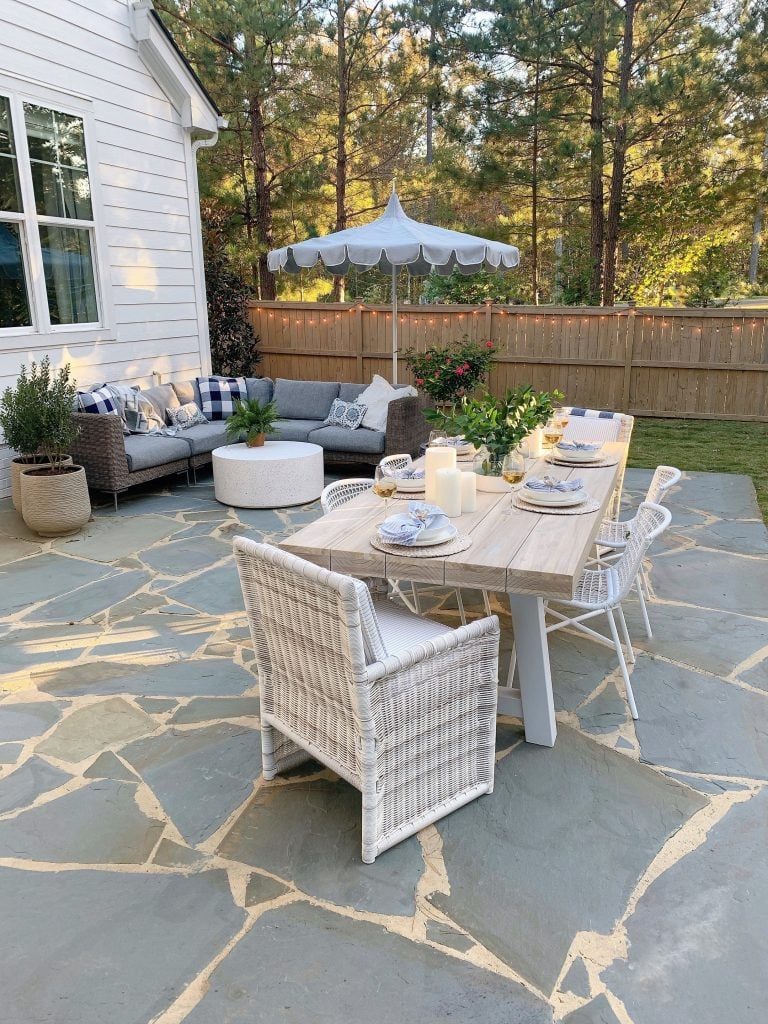
Pattern-cut bluestone (also called dimensional or ashlar pattern) uses rectangular pieces in repeating sizes — 12x12 up to 24x36 — for a tailored, formal floor with tight joints. It's the choice for dining terraces, pool decks and anywhere furniture needs to sit level. Irregular bluestone (flagging) uses natural broken shapes fitted like a puzzle, with wider planted or stone-dust joints — organic, cottage-to-estate versatile, and typically less expensive per square foot in material while costing somewhat more in fitting labor. Neither is "better": pattern reads architecture, irregular reads landscape. Many of the best New England properties use both — pattern at the house, irregular at the fire pit.
Decision two: thermal or natural cleft
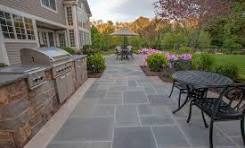
The surface finish question matters more here than buyers expect, and it has its own full comparison guide. The short version: thermal (flamed) bluestone is sawn flat then torch-textured — uniform thickness, consistent surface, the premium choice for dining areas and pool surrounds. Natural cleft keeps the stone's split face — more texture and color character, slightly less uniform, traditional New England to its core, and friendlier to the budget. Both are genuinely slip-resistant when wet, which matters through eight months of New England precipitation.
Decision three: dry-laid or wet-set
Dry-laid construction sets stone on a compacted gravel and stone-dust base — the time-tested New England method, flexible through freeze-thaw cycles, repairable stone by stone, and less expensive. Wet-set (mortared over a concrete slab) delivers a monolithic, dead-level surface with mortared joints — the high-formal look — at meaningfully higher cost, and it demands excellent drainage detailing because a slab that moves in frost cracks its joints. For most residential patios in our climate, a properly built dry-laid base of 6–8 inches of compacted gravel is the durability play; wet-set earns its premium on covered terraces and raised stoops.
What a bluestone patio costs in 2026
Real-world 2026 ranges for New England, combining material and professional installation: a typical 400-square-foot pattern bluestone patio lands between $7,000 and $11,000 dry-laid, with irregular flagging often 10–20% under pattern and mortared work well above both. The full cost guide breaks down every variable — access, base depth, joint treatment, and the regional labor differences between, say, Fairfield County and central Maine. Beware quotes dramatically below these ranges: in this trade, a cheap patio is almost always a shallow base, and a shallow base in New England is a heaved patio by the third winter.
The details that separate a 40-year patio from a 4-year one
- Base depth: 6–8 inches of compacted processed gravel minimum in our frost zone — the single biggest quality variable and the easiest corner to cut invisibly.
- Pitch: a proper eighth-to-quarter inch per foot away from the house; water management is winter management.
- Stone thickness: 1–1.5″ for pedestrian patios on a proper base; thicker for any vehicular surprise.
- Joints: polymeric sand or stone dust dry-laid; genuine mortar wet-set — and honest joint maintenance expectations either way (the maintenance guide covers the schedule).
- Edge restraint: the invisible frame that keeps a dry-laid field tight through decades of frost.
Getting it built
Tell us the square footage, the stone style you're drawn to, and your town in the free quote form — we'll return quarry-direct material pricing and installation options for your state, whether that's Connecticut, Massachusetts, Rhode Island, New Hampshire, Vermont or Maine. No pressure, no spam — numbers first, always.